Rusty: The Pony that Changed a Family — and Helped Advance Equine Medicine
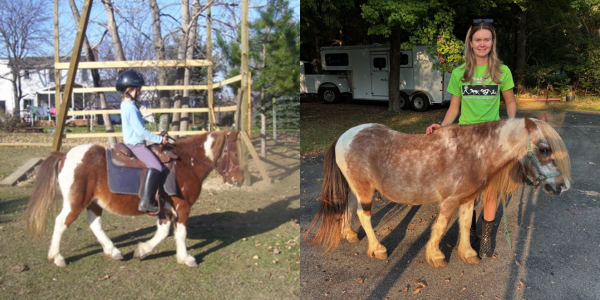
When Melissa Schott first met Rusty nearly 20 years ago, she was a 6-year-old girl simply looking for a pony to ride and enjoy around her family’s farm. She couldn’t have imagined then that the spirited chestnut and white pony would not only shape her as a rider, but would also make history as part of a groundbreaking veterinary study that still has implications today.
Mischief and Milestones
In those early days, Rusty was the quintessential pony, full of personality, cleverness and a dash of mischief. He became notorious for trying to rub Melissa against trees during rides, always testing her balance and determination. Yet, for all his antics, Rusty was also a patient teacher. He gave Melissa confidence, sharpened her skills and helped her move from casual rides at home to more advanced pursuits like jumping and, eventually, dressage with other horses.
“He was a stinker with me sometimes,” recalls Melissa. “But he was a really good boy when I had friends come to ride him. He’d let me lead him around anywhere with someone else on his back.”
Over the years, Rusty became more than just a pony to ride. He became a beloved member of the Schott family, a fixture on the farm and the cornerstone of Melissa’s equestrian future.
A Pioneer in Equine Medicine
In 2008, Rusty’s story took an unexpected turn. That year, he wasn’t shedding out normally and Melissa’s father, Harold Schott, DVM, PhD, DACVIM and a professor at Michigan State University (MSU) College of Veterinary Medicine, suspected Rusty might have pituitary pars intermedia dysfunction (PPID). PPID is a common condition, particularly in older horses and ponies. Besides not shedding out, other clinical signs of PPID can include increased thirst and urination, lethargy, muscle loss (especially the topline), increased abdominal fat, regional fat deposits around the tailhead and neck, abnormal sweating and recurrent infections or laminitis. Although Rusty didn’t show any of these additional clinical signs, Dr. Schott still suspected PPID and enrolled him in the clinical trial for PRASCEND® (pergolide tablets) at MSU.
Designed to help evaluate the safety and effectiveness of PRASCEND tablets as a treatment for PPID, the study was critical for gaining Food and Drug Administration (FDA) approval of the product, and Rusty was one of the ponies and horses that helped prove its safety and effectiveness. Today, PRASCEND remains the No. 1 medication for the treatment of PPID.
After his PPID diagnosis was confirmed, Rusty began treatment with half a tablet of PRASCEND daily. The results were profound: Not only did the medication help stabilize his health, but it allowed him to continue thriving well beyond what many would expect for a pony of his age.
Standing the Test of Time
Today, Rusty is estimated to be about 35 years old, making him a true senior citizen in the equine world. Yet, thanks to consistent overall care and his 17-year daily PRASCEND regimen, he continues to live comfortably at the Schott family farm.
But Rusty’s story doesn’t end with the initial trial. He was also included in a long-term follow-up study that tracked the original horses and ponies from the 2008 trial. These results confirmed what Melissa and other owners had experienced firsthand: The benefits of PRASCEND were not short-lived.
The long-term data told a powerful story:
- After 2.5 years, all owners reported sustained clinical improvement.
- At 3, 3.5 and 4.5 years, owners continued to be satisfied with treatment.
- By 5.5 years, even though many horses showed natural signs of aging — such as loss of muscle mass and swayback — owners reported their horses remained in good spirits and overall good health.
- Most importantly, 87% of owners said they would provide lifelong treatment for another horse diagnosed with PPID1.
Rusty’s longevity stands as a living testament to the long-term effectiveness of PRASCEND and the role that consistent PPID management can play in improving quality of life.
More than Medicine
For Melissa and the Schott family, Rusty is more than just part of a research story — he’s family. He’s the pony that shaped Melissa’s riding journey, the one that sparked her passion for dressage and the one that still greets them every day on the farm.
“He’s a little geriatric now,” says Dr. Schott. “He’s hard of hearing and not as quick as he used to be, but he still really enjoys being brushed and lying in the sunshine.”
Rusty’s contribution to equine medicine is extraordinary: He helped prove that a once-devastating diagnosis could be managed, giving horses and ponies with PPID the chance to live longer, healthier lives. But his greatest legacy may be the joy and lessons he has given to the people who love him most.
Rusty is not only a pioneer, he’s proof of what’s possible when science, medicine and the bond between human and horse come together.
IMPORTANT SAFETY INFORMATION: PRASCEND treatment may cause loss of appetite. Most cases are mild. PRASCEND has not been evaluated in breeding, pregnant or lactating horses. Adverse reactions may occur if animals other than horses ingest PRASCEND tablets. Not for human use. Do not ingest the product. PRASCEND tablets should not be crushed due to the potential for increased human exposure. Refer to the package insert for complete product information.
1Schott, HC, Strachota, JR, Marteniuk, JV & Refsal, KR (2025). Long-term response of equids with pituitary pars intermedia dysfunction to treatment with pergolide. Journal of Veterinary Internal Medicine, 39, e70109. Available at: https://onlinelibrary.wiley.com/doi/10.1111/jvim.70109. Accessed November 6, 2025.
PRASCEND® is a registered trademark of Boehringer Ingelheim Vetmedica GmbH, used under license. ©2025 Boehringer Ingelheim Animal Health USA Inc., Duluth, GA. All rights reserved. US-EQU-0445-2025-A